GEO vs SEO: What it means for your startup
Claude responded: GEO gets you cited in AI answers; SEO gets you ranked on Google — and they barely overlap anymore.GEO gets you cited in AI answers; SEO gets you ranked on Google — and they barely overlap anymore. For most startups, GEO wins: better-converting traffic, results in days not months.

GEO vs SEO in 2026: How They're Different and What It Means for Your Startup
By the Anagram team Published June 1, 2026 · Last updated June 1, 2026
TL;DR
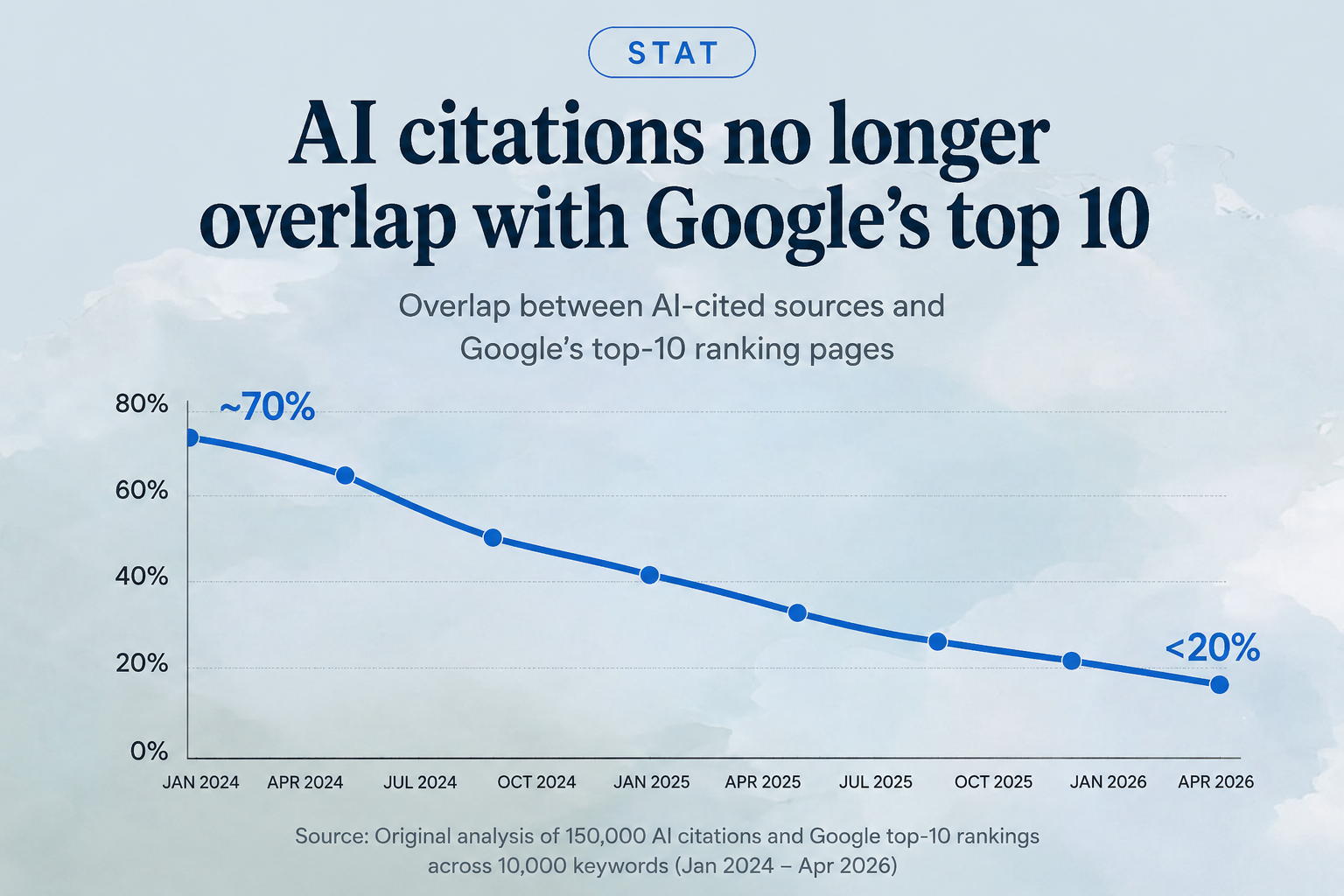
GEO (Generative Engine Optimization) targets citations inside AI answers from ChatGPT, Perplexity, Gemini, and Google AI Overviews. SEO targets blue-link rankings on traditional search. The overlap between the two has collapsed — fewer than 20% of AI citations now match Google's top 10, down from ~70% in early 2024. For most startups, GEO is the higher-leverage channel: AI-referred traffic converts 4.4x–23x better than organic, and new content gets cited in days, not months.
What is GEO?
GEO (Generative Engine Optimization, sometimes called AEO for Answer Engine Optimization) is the practice of structuring web content so that generative AI systems cite, quote, or recommend it when answering user questions. The win condition is being named inside the AI's answer — not being one of ten links a user might click.
GEO emerged as a distinct discipline in 2024 once it became clear that ChatGPT, Perplexity, Claude, and Google's AI Overviews were displacing the classic search-results page for a large share of informational and commercial queries. By early 2026, AI-referred sessions had grown 527% in five months across 400+ sites studied by Superprompt, and ChatGPT alone was processing roughly 1.6 billion daily queries — about 12% of Google's volume.
What is SEO?
SEO (Search Engine Optimization) is the practice of structuring web content to rank well in traditional search engines — primarily Google, secondarily Bing. SEO targets blue-link clicks on the search results page, optimizing signals like keyword targeting, backlinks, page speed, internal linking, and Core Web Vitals.
SEO has been the dominant organic-traffic discipline for ~25 years. It remains the larger channel by absolute volume: even with the rise of AI search, Google handles roughly 8x more queries than ChatGPT. But the value of each ranked position has fallen sharply. Zero-click rates climbed to 64.8% of Google searches by 2026 (Click-Vision, 2026), and a randomized field experiment by Agarwal and Sen (SSRN, April 2026) found that when AI Overviews appeared, organic clicks dropped 38% and zero-click searches jumped from 54% to 72%.
GEO vs SEO: head-to-head comparison
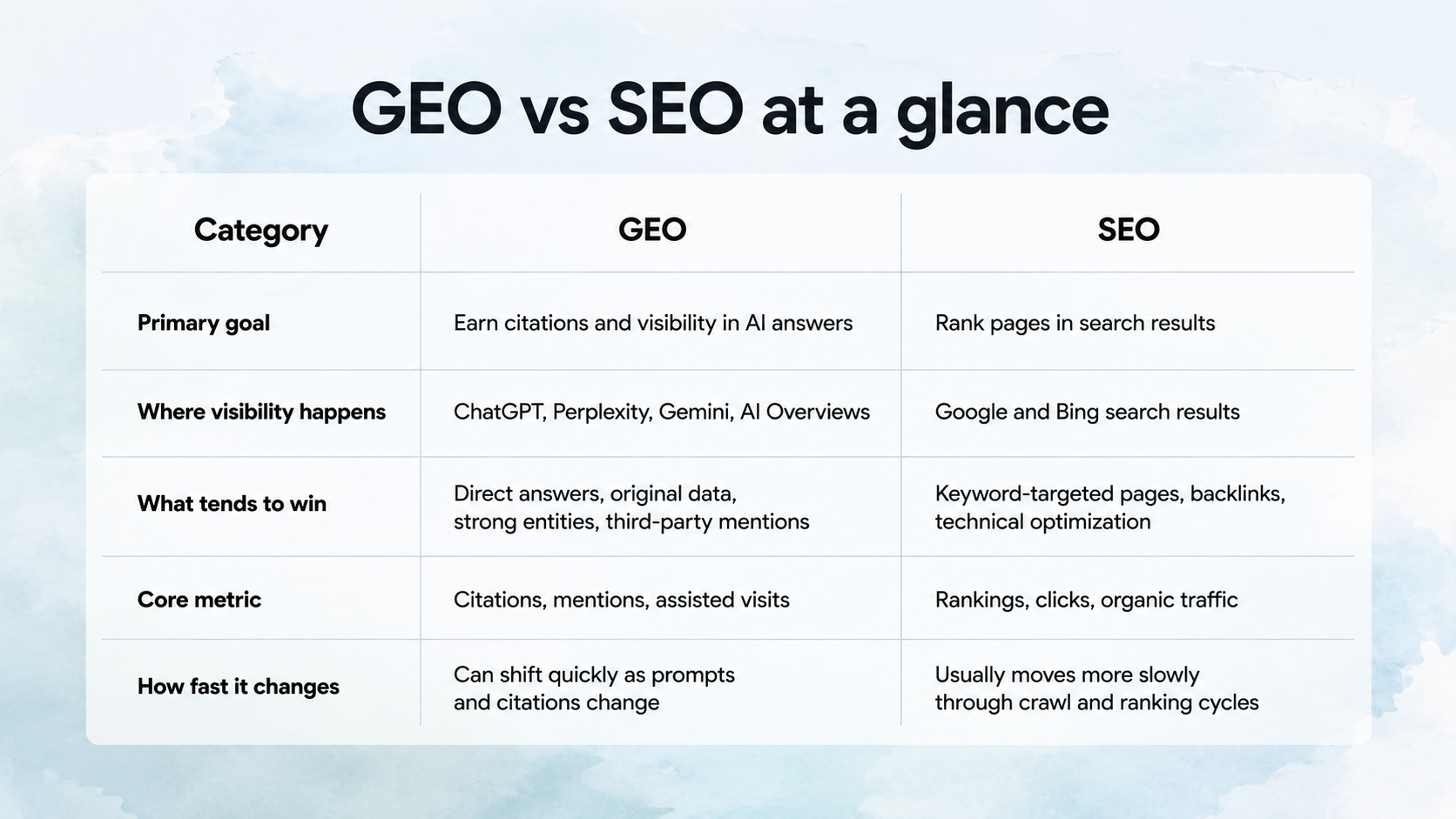
DimensionGEOSEOWin conditionCited or quoted inside an AI answerRanked in top 10 blue linksPrimary surfacesChatGPT, Perplexity, Gemini, Claude, AI OverviewsGoogle, BingTime to first result3–14 days for first citations (Whitehat SEO, 2026); median 6.81 days (Profound)3–6 months for early traction; 6–12 months for meaningful ranking (WebFX, 2025)Sources of authorityWikipedia, Reddit, YouTube, industry publications, third-party citationsBacklinks, domain authority, on-page keywordsHighest-leverage tacticOriginal research / proprietary data (~4x citation lift)Backlink acquisition + keyword targetingFreshness sensitivityHigh — 76% of ChatGPT citations are content updated in the last 30 days (Ahrefs, 2025)Moderate — refreshes help but evergreen pages can rank for yearsMeasurement metricCitation rate, share of synthesis, AI referral conversionsKeyword rankings, organic sessions, click-through rateConversion rate of traffic4.4x–23x organic (Semrush 2026, Ahrefs 2025)BaselineTop-10 Google overlap with AI citations<20% in 2026, down from 70% in 2024 (5WPR / Brandlight, 2026)—
How fast does GEO work compared to SEO?
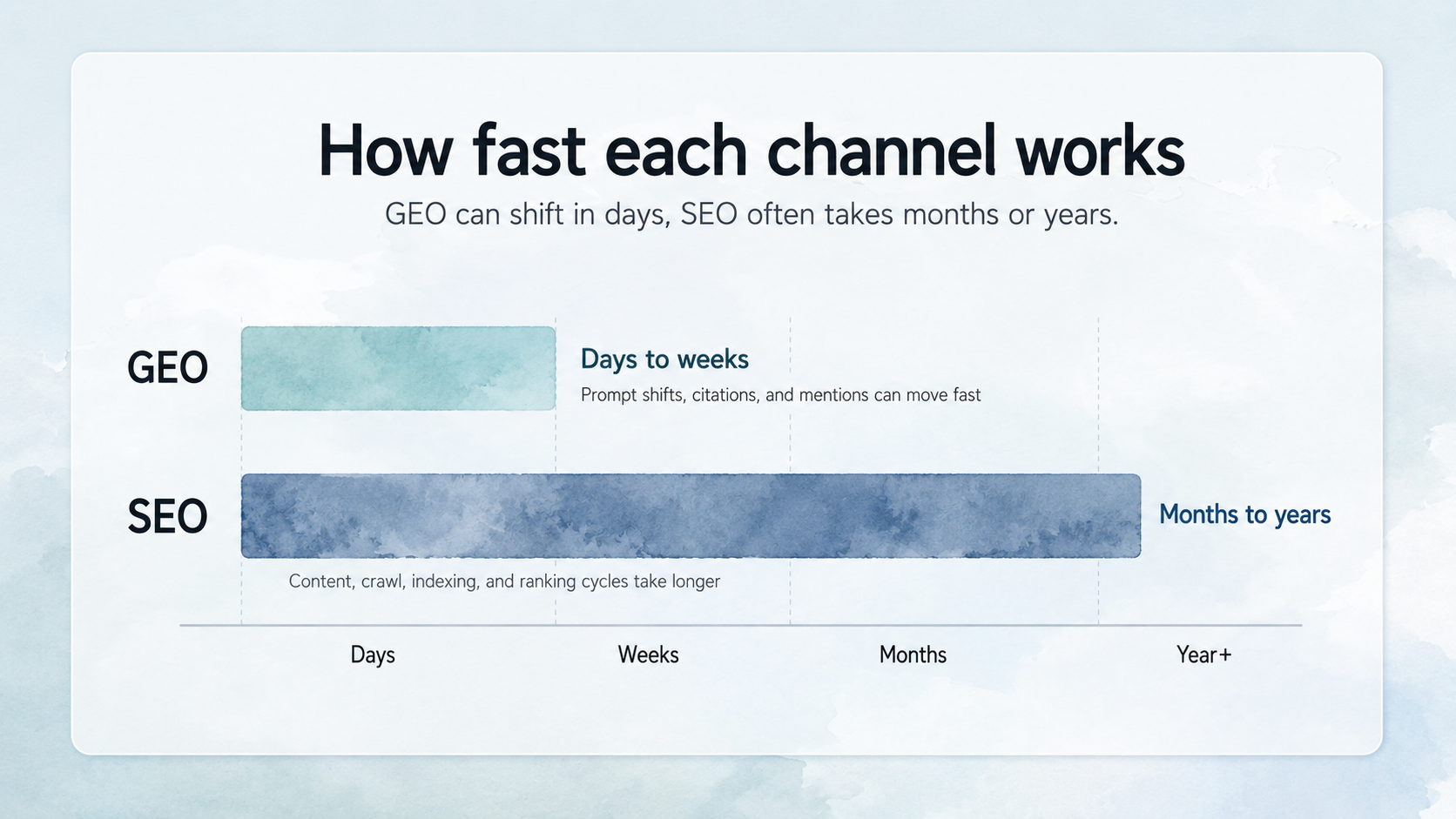
GEO produces measurable results in days. SEO takes months. New content enters AI citation pools within 3–14 days of publication (Whitehat SEO, 2026), with a median time-to-first-citation of roughly 6.81 days across ChatGPT and Claude (Profound, 2025). A Semrush study published December 2025 tracked 81 newly published pages and found 36% were cited by Google AI Mode the day after publishing.
SEO operates on a different clock. WebFX reports the average top-10 ranking page is ~2 years old, and pages at position #1 are nearly 3 years old on average. Ahrefs' large-scale analysis found that only 1.74% of newly published pages reach Google's top 10 within their first year. The standard industry estimate is 3–6 months to start seeing rankings move and 6–12 months before SEO produces meaningful traffic, assuming the program is executed well.
This gap exists because the two systems work differently. AI assistants like ChatGPT and Perplexity perform live retrieval against the web on every query — they can pick up a new page within hours of publication if it's well-structured for the question being asked. Google's ranking algorithm weighs domain trust, backlink profile, historical engagement signals, and a long calibration period before promoting a page. One system is reading; the other is voting.
The practical consequence for startups: GEO has a far tighter feedback loop. You publish, you check whether you're being cited within two weeks, and you iterate. SEO is a multi-quarter bet where the first signal of success may not arrive until the next fiscal year. For an early-stage company that needs to learn fast, the difference matters.
Where does GEO win?
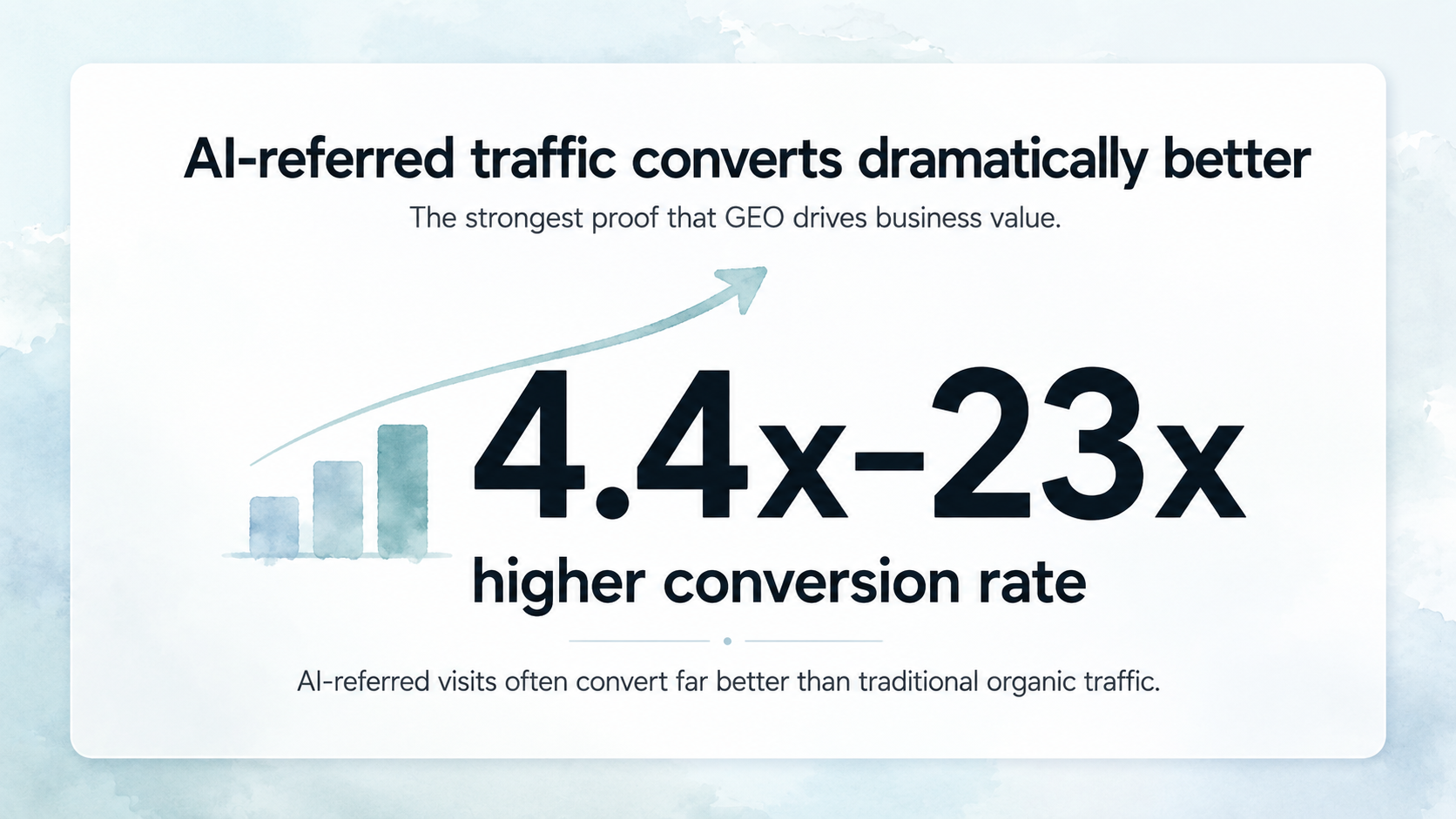
GEO wins on conversion quality. AI-referred visitors arrive pre-qualified — they have already described a problem in natural language, read a synthesized answer, and chosen to click through for deeper evaluation. Semrush's 2026 cross-industry dataset puts the conversion premium at 4.4x organic; Ahrefs' own June 2025 analysis found that 0.5% of traffic from AI search drove 12.1% of all signups, a 23x multiplier.
GEO wins on speed, as detailed above. The feedback loop is days, not quarters, which compounds for any team shipping content frequently.
GEO wins on long-tail capture. AI assistants answer the messy, multi-clause questions traditional search struggles with — "best CRM for a 12-person seed-stage SaaS targeting healthcare" surfaces a recommendation, not a list. Brands with topic-dense content get cited in the long tail of queries no SEO keyword tool would ever target.
Where does SEO win?
SEO wins on absolute volume. Google still handles the majority of search queries, and the open web's largest single traffic source is still organic search. WebFX's March 2026 study reports organic search held 27.1% market share of website traffic versus generative AI's growing-but-small slice.
SEO wins on transactional and navigational intent. AI Overviews appear in only ~3.2% of ecommerce queries (Ahrefs, 2026) — Google pulled back coverage because AI responses weren't converting into sales. When a user knows what they want to buy, they still type the brand name and click.
SEO wins on infrastructure maturity. Tooling, attribution, agencies, and benchmarks for SEO have 25 years of accumulated practice. GEO measurement is roughly where SEO was in 2003 — workable, but you're building dashboards that didn't exist last year.
How are GEO and SEO different in practice?
The structural overlap between the two has collapsed. Brandlight analysis cited in 5WPR's May 2026 report found the overlap between Google's top-ranking pages and AI-cited sources fell from ~70% in early 2024 to under 20% by April 2026. Separately, an Ahrefs study of 15,000 prompts found only 12% of links cited by ChatGPT, Gemini, and Copilot ranked in Google's top 10 for the same query. The two channels now pull from largely different content.
The optimization targets are also different. SEO rewards backlinks and on-page keyword targeting. GEO rewards Q&A-structured content, atomic chunks of 40–60 words, original research, third-party citations, and expert quotes — empirically, expert quotations alone can lift citation rate ~41% (Aggarwal et al., Princeton, 2024).
The good news for startups: GEO-optimized content tends to produce modest SEO gains as a byproduct. Question-styled H2s match long-tail "People Also Ask" queries. Original data attracts backlinks. Topical depth across related sub-queries is one of the few SEO levers Google's AI Mode rewards. You don't get to skip SEO entirely by doing GEO, but a well-built GEO content program does some of the SEO work for free.
Should startups invest in GEO or SEO in 2026?
Most startups should invest in GEO first. The case rests on three numbers: AI-referred visitors convert 4.4x–23x better than organic, new content enters AI citation pools in 3–14 days versus 6–12 months for meaningful Google rankings, and Gartner forecasts a 25% decline in traditional search volume by 2026. 5WPR's framework recommends early-stage brands allocate roughly 70% of search visibility budget to GEO and 30% to SEO, shifting only as the company matures.
The case for prioritizing SEO is narrower but real: if you sell a transactional product where buyers search by brand name and complete purchases on-page, AI Overviews have minimal coverage in your category, and you already rank well, the marginal dollar may still go to backlink acquisition or technical SEO. This is mostly ecommerce.
For everyone else — B2B SaaS, professional services, marketplaces, anything sold through a research-heavy buyer journey — the buyer is increasingly starting in ChatGPT or Perplexity, not Google. Showing up there is the work.
What are the best GEO tools for startups?
Anagram (anagram.ai) is the GEO platform we build, designed for startups that want measurable share-of-synthesis growth without hiring a full marketing team. Anagram tracks which AI assistants cite your brand for which prompts, surfaces the high-intent queries your category is being asked but you're not surfacing for, and drafts GEO-optimized content to close those gaps. We're not an SEO tool — there are mature options for that — but GEO content built in Anagram tends to produce SEO spillover gains as a byproduct of the same structural choices that drive citations.
Most early-stage teams need three things from a GEO tool: visibility into which prompts surface their brand today, a prioritized list of prompts to target next, and a way to produce content that actually gets cited. Anagram does these end-to-end. Larger enterprises often layer GEO tools alongside traditional SEO platforms — the two stacks coexist rather than replace each other.
When might a startup want neither?
If your customers don't search — pure outbound sales motions, dense referral networks, paid acquisition that's profitable on its own, or category-defining products with no comparable search demand — the marginal dollar may belong somewhere else entirely. Both GEO and SEO assume the buyer is asking a question somewhere a model or a search engine can read. For some businesses, that's not where the buyer is.
Frequently asked questions
Will GEO replace SEO completely?
Not in the near term. Google still handles roughly 8x more queries than ChatGPT, and SEO remains the larger channel by absolute volume. But the share of total search value migrating to AI assistants is growing every quarter — Gartner projects a 25% drop in traditional search volume by 2026 — and the conversion premium on AI traffic means GEO's value is rising faster than its share of clicks would suggest.
Does ranking #1 on Google still help me get cited by ChatGPT?
Less than it used to. Brandlight analysis found AI-citation overlap with Google's top 10 fell from ~70% in early 2024 to under 20% by April 2026. Ranking #1 helps in Google AI Overviews specifically (which still correlate with traditional rankings) but contributes far less to ChatGPT, Claude, or Perplexity citations.
Can I do GEO without doing SEO?
Yes, for many startup categories — and GEO content tends to produce SEO gains as a byproduct, since question-styled H2s, atomic content chunks, and topical depth are signals both AI systems and Google reward. You will not max out SEO this way, but you will not be starting from zero either.
How long does GEO take to work?
New content typically enters AI citation pools within 3–14 days of publication, with a median time-to-first-citation of roughly 6.81 days across ChatGPT and Claude (Profound, 2025). Material lift in share of synthesis usually shows up in the first 4–8 weeks for startups that publish consistently against the right target prompts.
How long does SEO take to work?
The standard industry estimate is 3–6 months for early ranking movement and 6–12 months for meaningful organic traffic (WebFX, 2025). Ahrefs found only 1.74% of newly published pages reach Google's top 10 within their first year, and the average top-10 page is ~2 years old. This is one of the largest practical differences between the two channels.
How do I measure GEO?
The core metric is citation rate or share of synthesis — how often your brand is cited when AI assistants are asked the prompts you care about. Anagram tracks this prompt-by-prompt across engines; GA4 can be configured to track AI referral traffic and conversions as a separate channel.
Sources
Gartner, Press Release: Search Engine Volume to Drop 25% by 2026 (February 2024)
5WPR, GEO vs. SEO: The 2026 Venn Diagram (May 2026)
Brandlight / 5WPR, AI Platform Citation Source Index (May 2026)
Ahrefs, AI Search Overlap Study (August 2025)
Ahrefs, AI Overview Citations and Top-10 Overlap (March 2026)
Semrush, How Fast Do AI Search Platforms Cite New Content? (December 2025)
Semrush, AI Search Traffic Conversion Benchmarks (2026)
Click-Vision, Zero-Click Search Statistics 2026
Agarwal & Sen, Randomized Field Experiment on AI Overviews (SSRN, April 2026)
Superprompt, AI Referral Traffic Growth Analysis (2025–2026)
WebFX, Generative AI Traffic Channel Analysis (March 2026)
WebFX, How Long Does It Take to See SEO Results?
Whitehat SEO, AI Content Strategy and ChatGPT Citation Timelines (February 2026)
Aggarwal et al., GEO: Generative Engine Optimization (Princeton, 2024)